Elena Márquez, PhD — Postdoctoral Research Associate, Systems Neuroscience
Madison, WI
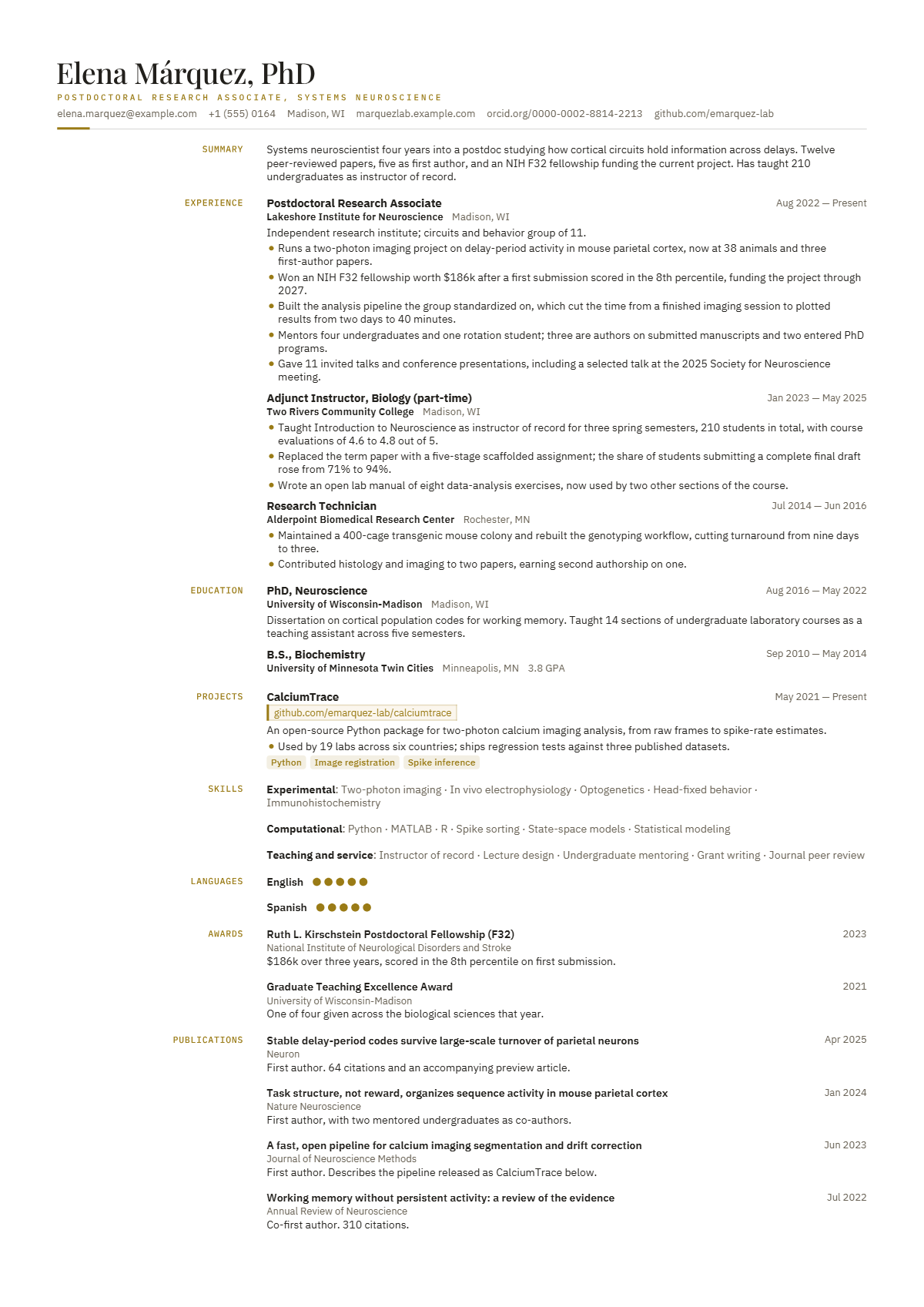
Systems neuroscientist four years into a postdoc studying how cortical circuits hold information across delays. Twelve peer-reviewed papers, five as first author, and an NIH F32 fellowship funding the current project. Has taught 210 undergraduates as instructor of record.
Experience
Postdoctoral Research Associate, Lakeshore Institute for Neuroscience · August 2022 – present
Independent research institute; circuits and behavior group of 11.
- Runs a two-photon imaging project on delay-period activity in mouse parietal cortex, now at 38 animals and three first-author papers.
- Won an NIH F32 fellowship worth 86k after a first submission scored in the 8th percentile, funding the project through 2027.
- Built the analysis pipeline the group standardized on, which cut the time from a finished imaging session to plotted results from two days to 40 minutes.
- Mentors four undergraduates and one rotation student; three are authors on submitted manuscripts and two entered PhD programs.
- Gave 11 invited talks and conference presentations, including a selected talk at the 2025 Society for Neuroscience meeting.
Adjunct Instructor, Biology (part-time), Two Rivers Community College · January 2023 – May 2025
- Taught Introduction to Neuroscience as instructor of record for three spring semesters, 210 students in total, with course evaluations of 4.6 to 4.8 out of 5.
- Replaced the term paper with a five-stage scaffolded assignment; the share of students submitting a complete final draft rose from 71% to 94%.
- Wrote an open lab manual of eight data-analysis exercises, now used by two other sections of the course.
Research Technician, Alderpoint Biomedical Research Center · July 2014 – June 2016
- Maintained a 400-cage transgenic mouse colony and rebuilt the genotyping workflow, cutting turnaround from nine days to three.
- Contributed histology and imaging to two papers, earning second authorship on one.
Projects
- CalciumTrace — An open-source Python package for two-photon calcium imaging analysis, from raw frames to spike-rate estimates.
Education
- PhD Neuroscience · University of Wisconsin-Madison · August 2016 – May 2022
- B.S. Biochemistry · University of Minnesota Twin Cities · September 2010 – May 2014
Skills
- Experimental: Two-photon imaging, In vivo electrophysiology, Optogenetics, Head-fixed behavior, Immunohistochemistry
- Computational: Python, MATLAB, R, Spike sorting, State-space models, Statistical modeling
- Teaching and service: Instructor of record, Lecture design, Undergraduate mentoring, Grant writing, Journal peer review
Why this Postdoctoral Research Associate résumé works
- The summary gives the three numbers a faculty search reads first: twelve peer-reviewed papers, five as first author, an NIH F32 fellowship, and 210 undergraduates taught as instructor of record.
- Funding is reported the way reviewers judge it, 86k scored in the 8th percentile on first submission, which signals the applicant can win grants independently.
- CalciumTrace, used by 19 labs across six countries and described in a first-author methods paper, shows research infrastructure that others depend on.
- Mentoring has outcomes, three undergraduates on submitted manuscripts and two now in PhD programs, which supports a teaching statement with evidence.
Postdoctoral Research Associate résumé: common questions
Should a postdoc use a resume or a CV?
A CV for academic jobs and fellowships, with full publication list, funding, teaching and talks. For industry roles, cut it to a two-page résumé that leads with skills and results and keeps only the most relevant papers.
How should publications be ordered on a postdoc CV?
Reverse chronological within one list, with your name in bold and first or co-first authorship marked. Add citation counts or notes such as an accompanying preview only for the papers where they help, and keep preprints in a separate group.
Loading CVAurum…