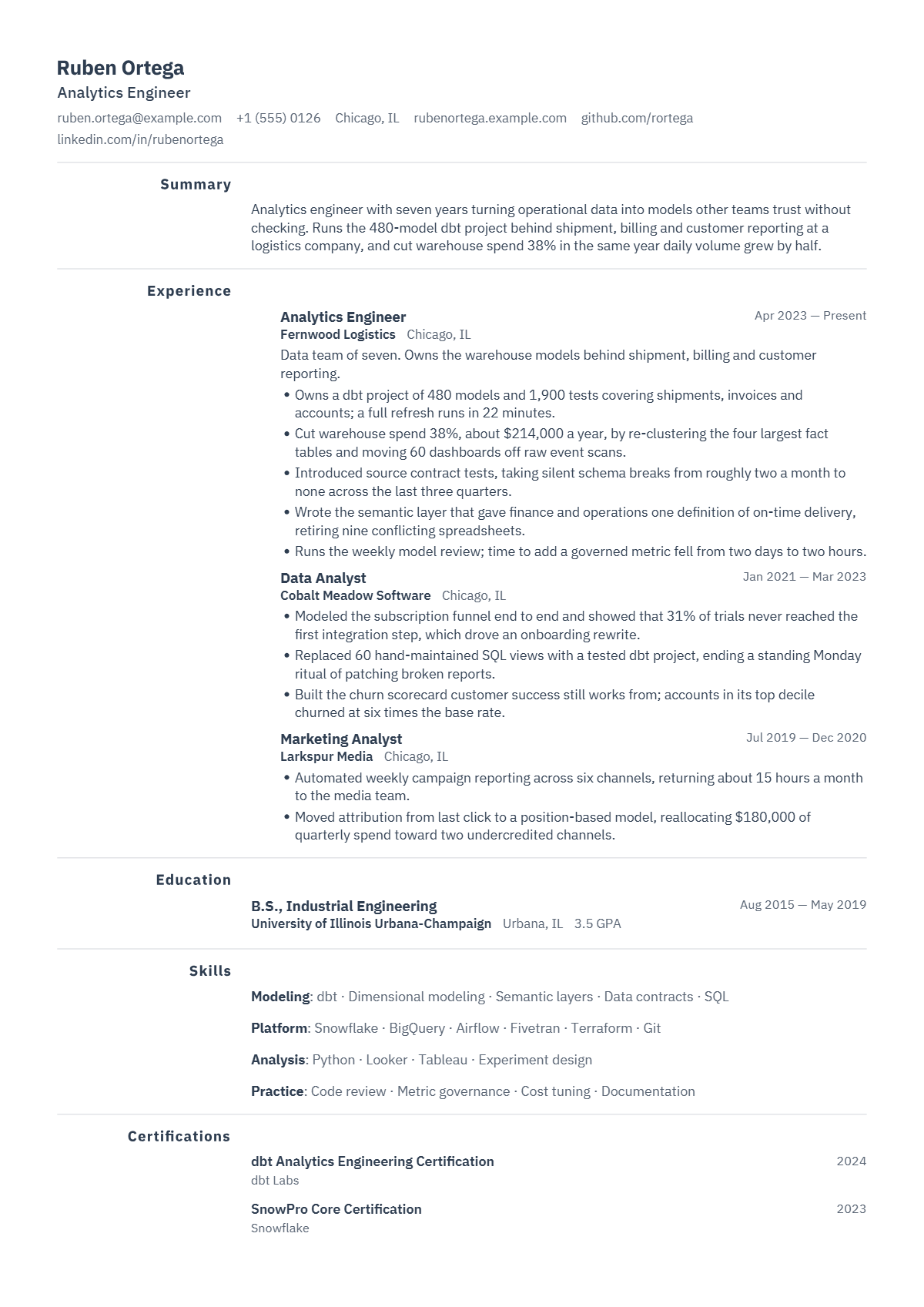
Analytics Engineer résumé example, in the Margin design
Modern analytics stack work told in outcomes: 480 tested models, 38% less warehouse spend, one agreed definition of on-time.
Written for United States, at mid level, in the data & analytics field, shown in the Margin design. Every name, employer, address and number below is invented.
Analytics engineer with seven years turning operational data into models other teams trust without checking. Runs the 480-model dbt project behind shipment, billing and customer reporting at a logistics company, and cut warehouse spend 38% in the same year daily volume grew by half.
Experience
Analytics Engineer, Fernwood Logistics · April 2023 – present
Data team of seven. Owns the warehouse models behind shipment, billing and customer reporting.
Owns a dbt project of 480 models and 1,900 tests covering shipments, invoices and accounts; a full refresh runs in 22 minutes.
Cut warehouse spend 38%, about
14,000 a year, by re-clustering the four largest fact tables and moving 60 dashboards off raw event scans.
Introduced source contract tests, taking silent schema breaks from roughly two a month to none across the last three quarters.
Wrote the semantic layer that gave finance and operations one definition of on-time delivery, retiring nine conflicting spreadsheets.
Runs the weekly model review; time to add a governed metric fell from two days to two hours.
Data Analyst, Cobalt Meadow Software · January 2021 – March 2023
Modeled the subscription funnel end to end and showed that 31% of trials never reached the first integration step, which drove an onboarding rewrite.
Replaced 60 hand-maintained SQL views with a tested dbt project, ending a standing Monday ritual of patching broken reports.
Built the churn scorecard customer success still works from; accounts in its top decile churned at six times the base rate.
Marketing Analyst, Larkspur Media · July 2019 – December 2020
Automated weekly campaign reporting across six channels, returning about 15 hours a month to the media team.
Moved attribution from last click to a position-based model, reallocating
80,000 of quarterly spend toward two undercredited channels.
Education
B.S. Industrial Engineering · University of Illinois Urbana-Champaign · August 2015 – May 2019
Skills
Modeling: dbt, Dimensional modeling, Semantic layers, Data contracts, SQL
The scale of the work comes first: “480 models and 1,900 tests” and a full refresh in 22 minutes tell a data lead the size and health of the dbt project before any tool list does.
Cost is written in money as well as percent. Cutting warehouse spend 38%, “about
14,000 a year”, by re-clustering the four largest fact tables shows the engineering choice behind the saving.
The semantic-layer bullet names a business outcome, one definition of on-time delivery and “nine conflicting spreadsheets” retired, which is the part of analytics engineering hiring managers find hardest to test in interview.
The path from Marketing Analyst at Larkspur Media to Analytics Engineer at Fernwood Logistics is kept in order, so the move from reporting to owning models reads as a progression rather than a title change.
Analytics Engineer résumé: common questions
What skills should an analytics engineer resume list?
Group them: modeling (dbt, dimensional modeling, SQL), platform (Snowflake or BigQuery, Airflow, Fivetran), and analysis or BI tools (Looker, Tableau, Python). Then show the important ones in bullets, for example the size of the dbt project you run and how it is tested.
Are dbt and Snowflake certifications worth adding to a resume?
They help when they back up experience already on the page. The dbt Analytics Engineering Certification and SnowPro Core are recognised by data teams, but list them in a certificates section below the work, not in place of bullets about real models.
How is an analytics engineer resume different from a data analyst resume?
An analyst résumé is judged on findings and decisions; an analytics engineer résumé is judged on the models, tests and definitions other people rely on. Lead with what you built and keep running, its size, its reliability and its cost.